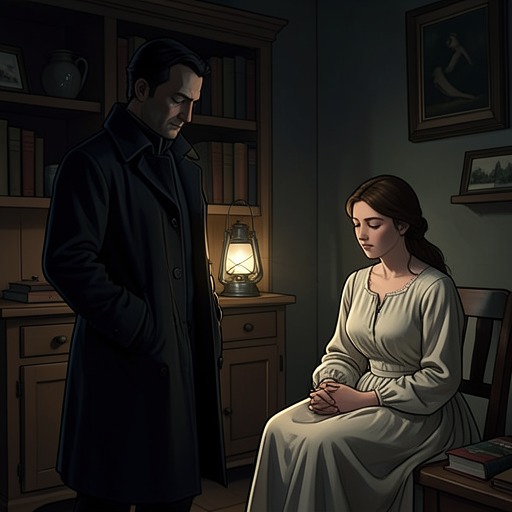
Peter and Jemima's relationship
When You Were MinePeter and Jemima's relationship is an unfinished love story shaped by separation, Peter's sense of failure, and his enduring refusal to replace Jemima with a marriage without love. Though Jemima is absent from the conversation in which the relationship is disclosed, her remembered danger and the secret she entrusted to Peter remain active in his life. Isobel's offer to help find her turns private regret into a shared undertaking, but the possibility of reunion remains uncertain.
Origins and separation
Peter's history with Jemima emerges when Isobel asks why he has never married. After a long silence, he identifies her as the woman he once loved. He remembers her beauty, but the central fact of the relationship is not his description of her appearance: it is his conviction that he made a grave mistake and lost her. He had intended to ask her to marry him, but she left before he did so.
Jemima was in trouble and needed Peter's help. He says he failed her, and describes the secret she told him and the assistance she requested as connected to his own past. The danger surrounding her brought them together as well as placing their relationship under strain: Peter agreed to help, and they fell in love, although he qualifies that account by saying he fell in love with her and only thought she had feelings for him. His recollection therefore contains both attachment and uncertainty about whether that attachment was mutual.
The separation is not explained in full. Peter says there is much more to the story than he can tell at that moment. What he does disclose is enough to make his regret concrete: Jemima faced danger, turned to him, and left before he could make the marriage proposal he had contemplated. The missed proposal is not presented as the sole cause of her departure; rather, it underscores how late Peter believes he was in offering the commitment he wanted to make.
Peter's continuing attachment
By the time Isobel asks about his unmarried state, the lost relationship still determines Peter's choices. He admits that he may eventually be expected to marry and establish a family, but cannot bear the prospect of marrying a woman he does not love. He cannot close off his affections for Jemima. His reluctance is thus not a general rejection of marriage: it is a refusal to treat marriage as an obligation that can be fulfilled without the love he associates with her.
Peter's feelings appear in the way he recounts the past as well as in what he says. He pauses to gaze into the fire before answering Isobel; at the memory of Jemima, sadness crosses his face, and he takes a long drink. When he describes having failed her, he rises and moves towards the fire. These gestures give his account the quality of a wound he has not put behind him. His voice hardens when he explains Jemima's social position, then he falls silent, apparently braced for Isobel to condemn his choice.
He has not stopped looking for her. Jemima came from Cornwall and was living in Derbyshire, near where Peter is now. He explains that his time in the area gives him an opportunity to make inquiries, in addition to allowing him to spend time with Isobel and Dominic. The search has not succeeded: Isobel recognizes from his response that he has not found Jemima. His continued presence near her former home gives his attachment a practical dimension, though it has not yet brought them back into contact.
Isobel's intervention
Isobel does not respond to Peter's disclosure with the censure he expects. She initially registers surprise that Jemima was a servant, especially given the many fashionable women who have shown interest in Peter. Peter clarifies that Jemima served in Dominic's uncle's household but did not come from a background of service. His insistence and weary manner suggest how exposed he feels in telling his sister a story that crosses an expected social boundary.
Instead of treating Jemima's status as a reason the relationship should end, Isobel urges Peter to find her and marry her if they can. She offers to make inquiries with him, asks what he has already learned, and promises to continue the search when she returns to Willowbrook. Peter is astonished that she accepts his decision so readily. Her offer changes the relationship's immediate circumstances: the search is no longer Peter's private effort alone, but something his sister is prepared to pursue with him.
Isobel's support rests on her understanding of what deprivation can do. She does not want Jemima to remain in servitude if she could instead be beside Peter and share the happiness he deserves. Her response also draws on her own desperate experience of survival: she remembers that, without Dominic's love and support, she would have remained on the streets and probably died of cold and hunger. That history informs her insistence that the possibility of finding a loving companion matters materially, not merely romantically.
An unresolved future
Peter raises the possibility that Jemima may already be married to someone else, and his voice catches as he contemplates it. Isobel refuses to let that fear decide the matter before they know the facts. She argues that if Jemima loves Peter as much as he loves her, she will not have married another, and declares that they will uncover her whereabouts. Her confidence is a commitment to search, not proof that Jemima remains free or that she returns Peter's feelings.
The relationship therefore remains unresolved at the point of disclosure. Peter's account establishes love, separation, an unfulfilled intention to propose, and a continuing search; it does not reveal what Jemima did after leaving, whether she still loves him, or whether the two will meet again. Isobel's determination offers Peter renewed assistance, while his fear of finding Jemima beyond his reach preserves the uncertainty. Their story gives Peter's bachelorhood a specific emotional history and makes his future depend on a woman who is still absent.